
A Comprehensive Guide to 1099 Reporting and Filing: Preparing for Year-End

A Comprehensive Guide to 1099 Reporting and Filing: Preparing for Year-End

In today’s complex business landscape, keeping up with regulations is critical to maintaining a company’s smooth operations. As November begins, businesses face an important compliance milestone that requires early attention: 1099 reporting and filing. With the rapid growth of independent contractors, freelancers, and specialized service providers, organizations must accurately report non-employee compensation to the Internal Revenue Service (IRS). In this blog, we will explore the significance of 1099 reporting, essential filing steps, top software tools, and how proactive preparation in November ensures full compliance well before year-end deadlines.

What Is a 1099 Form?

A 1099 form is a critical tax document used to report income received by individuals or businesses that are not classified as traditional employees. Commonly issued to independent contractors, freelancers, and service providers, the 1099 helps both the payer and the recipient track taxable income for federal reporting purposes. Under IRS regulations, all U.S. businesses that make qualified payments to non-employees must submit these informational returns. The primary goal is to ensure that the government can verify income earned outside of standard employment, promoting financial transparency across the economy.

Common Types of 1099 Forms

While there are multiple variations of information returns, two specific forms cover the vast majority of corporate vendor payments:
  • Form 1099-NEC (Nonemployee Compensation): Used strictly to report payments made to independent contractors, freelancers, and professional service providers who earn $600 or more during the calendar year.
  • Form 1099-MISC (Miscellaneous Information): Used to report other specific business disbursements, including commercial rent, legal proceeds, royalties, healthcare payments, or prizes and awards.

How Do You File a 1099 Form?

Achieving full 1099 compliance requires a structured, multi-step process that should begin well before official reporting windows open in January:

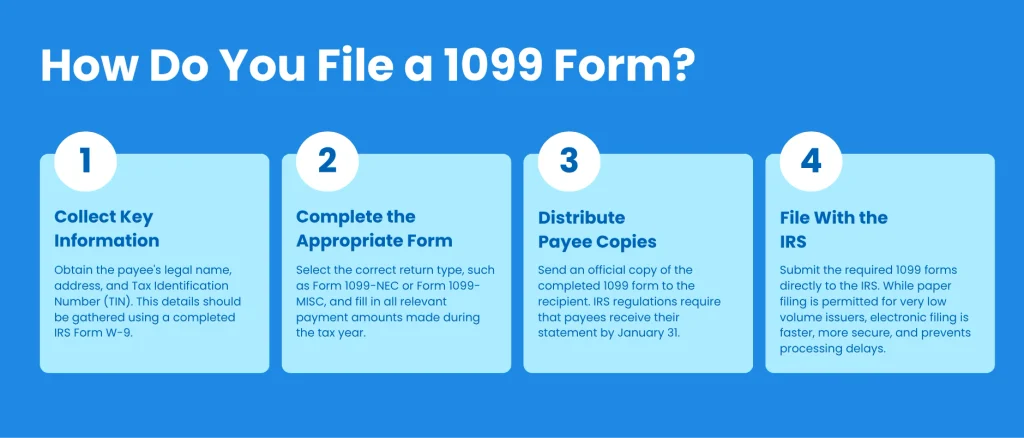
  1. Collect Key Information: Obtain the payee’s legal name, address, and Tax Identification Number (TIN). This details should be gathered using a completed IRS Form W-9.
  2. Complete the Appropriate Form: Select the correct return type, such as Form 1099-NEC or Form 1099-MISC, and fill in all relevant payment amounts made during the tax year.
  3. Distribute Payee Copies: Send an official copy of the completed 1099 form to the recipient. IRS regulations require that payees receive their statement by January 31.
  4. File With the IRS: Submit the required 1099 forms directly to the IRS. While paper filing is permitted for very low volume issuers, electronic filing is faster, more secure, and prevents processing delays.

Best Software Tools for 1099 Reporting

To make the filing process more manageable, several software platforms are available to streamline data collection, calculation, and electronic submission:

  • QuickBooks: Ideal for small to mid-sized businesses, QuickBooks automates 1099 preparation by tracking eligible vendor payments throughout the year and integrating directly with your accounting ledgers.
  • Gusto: Designed to handle both payroll and contractor management, Gusto simplifies the process of generating, distributing, and submitting 1099 forms electronically.
  • Tax1099: A cloud-based e-filing platform designed specifically for high-volume reporting, compatible with various accounting systems like QuickBooks and Xero.
  • TurboTax: Best suited for small business owners and sole proprietors seeking a simple, step-by-step guided filing workflow.

Why Is 1099 Reporting Important?

1. Regulatory Compliance

Filing 1099 forms demonstrates your commitment to adhering to federal tax regulations. Maintaining a clean compliance record minimizes the risk of federal audits and reinforces the credibility of your business with partners and financial institutions.

2. Accurate Financial Records

Tracking non-employee payments through systematic 1099 reporting simplifies overall year-end accounting. Maintaining organized vendor ledgers gives leadership a clear financial history and supports accurate cash flow planning.

3. Avoiding Severe IRS Penalties

Timely filing protects your organization from costly administrative fines. The IRS imposes strict penalty structures for missing or delayed returns, making proactive filing essential to preserving operational capital.

Consequences of Non-Filing

1. Steep Fines and Statutory Penalties

Failing to submit 1099 forms on time leads to progressive penalties from the IRS. Late filing fines range from $60 to $340 per form, depending on how late the report is submitted. In cases of intentional disregard for filing rules, penalties can exceed $680 per form with no maximum cap.

2. Increased Risk of Audits

Missing, late, or inaccurate 1099 submissions raise immediate flags within automated IRS matching systems. Discrepancies between reported vendor expenses and contractor tax returns significantly increase the likelihood of a comprehensive corporate audit.

3. Legal and Operational Liabilities

Persistent reporting errors or failure to obtain vendor tax numbers can trigger backup withholding notices. This requires your business to withhold 24 percent of future payments to non-compliant vendors, damaging key vendor relationships and creating unnecessary legal administrative work.

Final Thoughts

Proper 1099 reporting is more than an annual administrative chore, it is a vital component of robust corporate governance and tax compliance. Waiting until January to gather vendor W-9 forms or reconcile contractor ledgers introduces unnecessary risk and operational stress. By reviewing contractor payments and organizing tax records in November, businesses can avoid penalties, streamline year-end closes, and protect their financial standing.

MontPac’s Recommendation

At MontPac, we specialize in making 1099 filing straightforward and stress-free. We recommend that business owners perform a comprehensive vendor audit during the month of November to verify TINs and gather missing W-9 forms well before reporting deadlines. With years of experience managing tax filings for a wide range of organizations, our team handles the entire process, from data collection and ledger reconciliation to final electronic submission. Reach out to MontPac today to ensure your business remains fully compliant with all IRS requirements.

Frequently Asked Questions

  • What is the deadline for filing Form 1099-NEC?
    Form 1099-NEC must be filed with the IRS and furnished to recipients on or before January 31 following the applicable tax year.
  • What is the primary difference between Form 1099-NEC and Form 1099-MISC?
    Form 1099-NEC is dedicated strictly to reporting non-employee compensation paid for contractor services. Form 1099-MISC is used for miscellaneous corporate disbursements, such as commercial rent, royalties, or legal settlements.
  • Are payments made via credit card or PayPal reported on Form 1099-NEC?
    No. Payments made to contractors via credit card, PayPal, or third-party payment networks are generally reported by those processors on Form 1099-K, meaning your business does not need to issue a separate Form 1099-NEC for those specific payments.
  • What happens if a vendor refuses to provide a W-9 form?
    If a vendor fails or refuses to provide a Form W-9, IRS regulations require your business to begin backup withholding at a flat rate of 24 percent on all future disbursements and report the situation to the IRS.

If your business relies on independent contractors and service providers, taking proactive control of your 1099 obligations in November is a critical step toward a smooth year-end financial close.

Why Is a November Vendor Audit Essential?

Auditing your contractor ledgers prior to the December holiday rush provides several strategic advantages:

  • Ample time to collect updated W-9 forms from remote workers, freelancers, and service partners.
  • Opportunity to verify Tax Identification Numbers (TINs) against IRS matching databases to prevent filing errors.
  • Clear distinction between 1099-eligible direct payments and third-party payment processor disbursements.
  • Reduced administrative burden on your internal accounting staff during peak January tax season.

How MontPac Simplifies 1099 Compliance

Managing multi-vendor tax records requires accuracy, modern technical tools, and consistent execution. MontPac supports your business through every stage of the compliance process:

  1. Ledger Auditing: We review your general ledger to identify all 1099-eligible vendor disbursements and verify threshold amounts.
  2. W-9 Collection and Data Verification: We systematically gather missing tax documentation and verify contractor TINs to prevent penalty notices.
  3. Automated Software Management: We utilize advanced accounting software integrations to generate, review, and e-file returns securely.
  4. End-to-End Submission: We handle the full distribution process, ensuring payees receive their copies on time and federal agencies receive accurate submissions.

By establishing strong compliance workflows in November, your organization can avoid costly IRS penalties, protect working capital, and approach the new fiscal year with complete confidence.

    Comments are closed

    MontPac logo
    About
    Montgomery Pacific Corporation (MontPac) is the foremost outsource accounting and CFO Advisory firm for the past 20 years. Whether you are a startup, hypergrowth company or venture fund, we provide a complete set of back-office services so you can focus on growing your organization. We are your strategic partner at every stage and collaborate with you and your team on your vision.
    Julie, MontPac testimonial profile photo
    Find out why 90% of our customers come from referrals
    Subscribe to our Newsletter
    Read about the latest accounting and business insights here.

    Accelerate Your startup's growth with montPac's expert financial guidance

    Fill out the form below, and our team will reach out to discuss how we can help optimize your practice's financial health.
    Name