
In today’s fast-moving digital economy, staying on top of state and federal regulations is essential to keeping your business running smoothly. While expanding into e-commerce makes it easier than ever to reach customers everywhere, managing multi-state tax obligations can quickly become a major operational hurdle. Following landmark legal decisions, state authorities now require online retailers to track, collect, and remit sales tax across multiple jurisdictions. In this blog, we will take a closer look at what e-commerce tax compliance involves, the key challenges growing brands face, and how to protect your business from costly surprises down the road.
At its core, e-commerce tax compliance means identifying where your business creates tax obligations, registering with the appropriate state agencies, and accurately collecting and remitting sales tax. Under modern “economic nexus” laws, you no longer need a physical storefront or warehouse in a state to owe taxes there. If your sales or transaction volume crosses a state’s designated threshold, you are legally required to comply with its tax rules. The goal of these regulations is to level the playing field between local brick-and-mortar stores and remote online sellers.
Because each state sets its own rules, managing the economic nexus is one of the most frustrating parts of scaling an online store. Many states set a baseline threshold of $100,000 in annual sales or 200 separate transactions. However, these limits vary widely. Crossing a threshold creates an immediate requirement to register and begin collecting sales tax, meaning businesses must constantly monitor their state-by-state sales data to avoid falling behind.
If you sell on platforms like Amazon, Walmart, or Etsy, you have likely seen them handle sales tax automatically on your behalf under Marketplace Facilitator laws. While this takes a huge load off your shoulders for platform sales, it does not mean your business is completely off the hook. Revenue from these marketplaces still counts toward your overall economic nexus thresholds. If those sales push you over the line in a state, you may now be required to collect sales tax on your direct-to-consumer website as well. Furthermore, several states still require you to file “zero-dollar” informational tax returns to report your total sales volume, even if the marketplace remitted the actual tax dollars for you.
If you rely on Fulfillment by Amazon or third-party logistics providers (3PLs) to handle warehousing and shipping, your inventory is routinely moved across a network of regional fulfillment centers. What many business owners do not realize is that storing physical goods on a warehouse shelf creates an instant “physical nexus.” Even if you have only made a few sales in a particular state, having inventory stored there automatically establishes a tax obligation.
With over 13,000 local tax jurisdictions in the United States, determining the correct tax rate at checkout is a complex task. To make matters more complicated, states often disagree on what is actually taxable. For instance, apparel may be tax-exempt in one state, taxed at a reduced rate in another, or fully taxable across the border. Shipping fees and digital goods face similarly fragmented rules. Trying to manage these variations manually across a large product catalog without dedicated tax software opens the door to frequent errors.
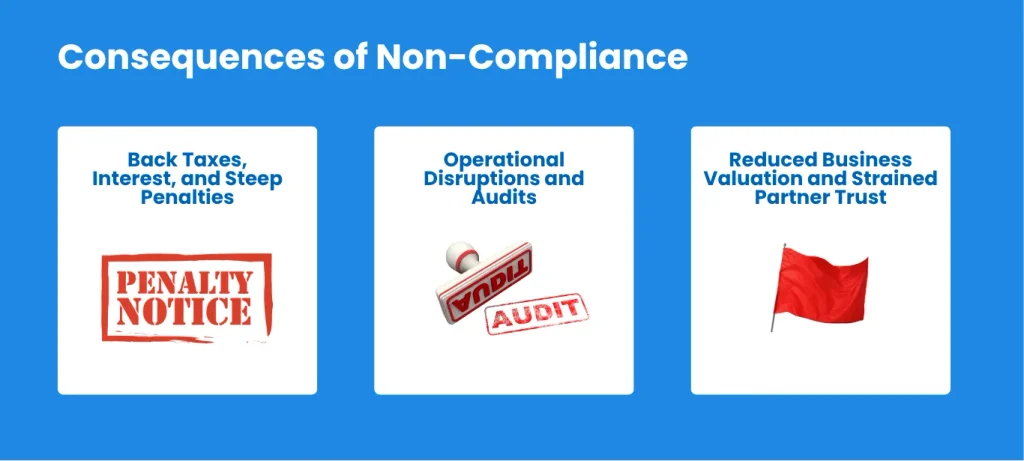
Failing to register and collect sales tax on time can lead to significant financial strain. State revenue departments hold the seller, not the buyer, responsible for uncollected taxes. This means any back taxes owed will come directly out of your operating margins. On top of the original tax bill, states levy substantial interest and late-filing penalties that accumulate quickly over time.
Being flagged for non-compliance often triggers state tax audits. Resolving an audit requires considerable time, effort, and financial resources, taking your team’s focus away from growing the business. In severe cases of persistent non-compliance, states have the authority to freeze business bank accounts or revoke your ability to conduct business in that state.
Unmanaged tax liabilities can complicate routine financial reviews, loan applications, and investor due diligence. If you plan to seek funding, secure a credit line, or eventually sell your company, unresolved sales tax exposure will show up as a major red flag, potentially lowering your valuation or stalling negotiations altogether.
Staying compliant with state sales tax laws is more than just a regulatory box to check. It is an essential part of protecting your cash flow, preserving your reputation, and building a foundation for sustainable scale. By proactively tracking your nexus thresholds, automating your tax software integrations, and keeping accurate sales records, you can keep your business compliant and focus on what matters most, growing your brand.
At MontPac, we understand how challenging multi-state tax compliance can be for growing e-commerce companies. We recommend that business owners regularly review their state-by-state sales data and implement automated tax calculation software early on. Taking a proactive approach prevents unexpected back-tax liabilities and eliminates unnecessary stress during tax season. If you need support reviewing your state tax exposure or streamlining your accounting systems, reach out to our team today. We are here to help you navigate regulatory requirements with confidence.
What is the economic nexus?
Economic nexus is a tax principle where a business becomes obligated to collect and remit state sales tax once it hits a specific threshold of sales revenue or transaction count in that state, even without a physical office or staff present.
Do I still need to file tax returns if Amazon collects sales tax for me?
Yes, in many cases. Certain states require businesses to file informational tax returns showing their gross sales, even if the marketplace platform remitted the actual tax on those transactions.
What happens if I cross a sales threshold and do not realize it?
If you cross a state threshold without registering, the state holds your business liable for the uncollected tax. You will have to pay those back taxes out of your business profits, along with accrued interest and penalty fees.
When should our business start tracking state tax thresholds?
You should review your sales volume, transaction counts, and inventory locations monthly. Keeping a close eye on your trajectory allows you to register in new states before crossing thresholds rather than scrambling after the fact.