

United States Tax Compliance and Filing Obligations for January 2026
January is one of the busiest compliance months for U.S. businesses. Between federal filings, state tax payments, payroll reporting, and license renewals, deadlines stack up quickly especially for companies operating in multiple states.
This article is a quick reminder to double-check your January tax and compliance filings. The start of the year brings some of the most deadline-heavy obligations for U.S. businesses, from federal payroll filings to state tax payments, 1099s, W-2s, and more.
Table of Contents
- Federal Obligations (All States)
- State-Level Obligations Commonly Due in January
- January Compliance Quick Checklist
- MontPac’s Recommendation
Federal Obligations (All States)
By January 15
- Q4 Estimated Income Tax Payment
- Applies to C-corps and pass-through owners making quarterly estimates
- IRS Form 1120-W (calculation reference)
By January 31
- Form W-2 → Employees
- Form W-3 → Social Security Administration
- Form 1099-NEC / 1099-MISC → Contractors & recipients
- Form 941 (Q4) → Payroll tax return
- Form 940 → FUTA (unless fully deposited earlier)
- Backup withholding deposits (if applicable)
State-Level Obligations Commonly Due in January
These apply based on nexus (physical, economic, or employee presence).
1. State Income & Franchise Taxes
Common January Requirements
- Q4 estimated tax payments (many states align with federal Jan 15 date)
- Annual franchise / privilege taxes due in some states
Examples
- Texas: Franchise tax no January payment, but annual obligation exists later
- California: Minimum franchise tax already paid, but estimates may apply
- New York: Q4 estimated corporate or pass-through payments du
2. Sales & Use Tax
January Activity
- December sales tax filing & payment
- Filing frequency depends on state (monthly filers most affected)
Examples
- CA, NY, TX, FL: December sales tax returns typically due Jan 20–31
- Remote sellers: Must file if economic nexus thresholds are met
3. Payroll & Employment Taxes (State)
Common January Deadlines
- Q4 State Withholding Returns
- Q4 State Unemployment Insurance (SUI) Returns
- Annual wage reconciliation forms (state equivalents of W-2/W-3)
Examples
- California: DE-9 / DE-9C due Jan 31
- New York: NYS-45 due Jan 31
- Texas: SUI quarterly report due Jan 31
4. Annual Reports & Entity Compliance
Some states require annual or biennial reports in January:
Examples
- Delaware: Annual Franchise Tax & Report due March, but January prep is critical
- Nevada: Annual List often due in anniversary month (many January formations)
- Multiple states: Registered agent renewals often occur in January
5. Business Licenses & Renewals
- State or local business licenses may renew January 1–31
- Professional, industry, or city licenses commonly reset at year-end
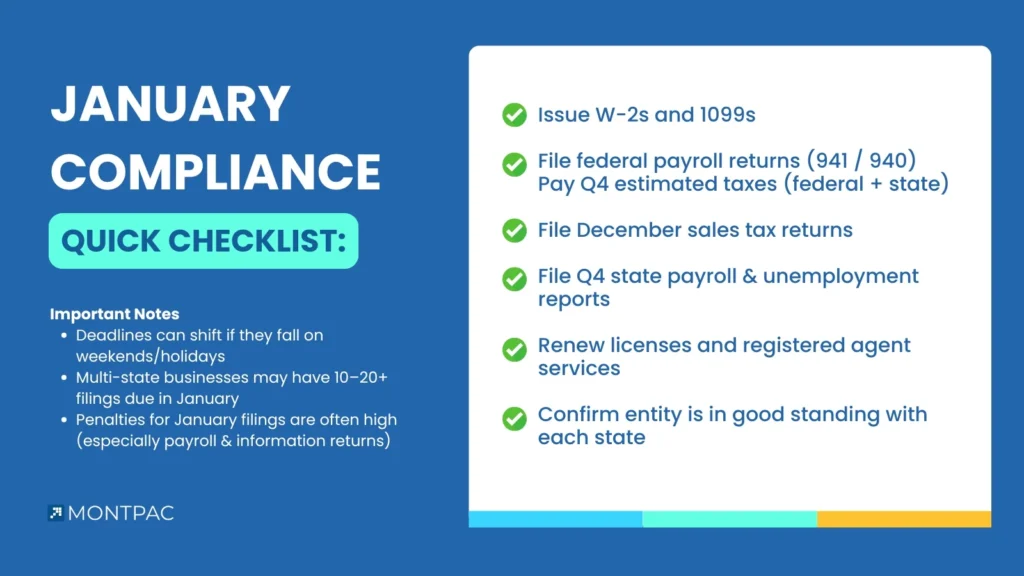
JANUARY COMPLIANCE QUICK CHECKLIST
✔ Issue W-2s and 1099s
✔ File federal payroll returns (941 / 940)
✔ Pay Q4 estimated taxes (federal + state)
✔ File December sales tax returns
✔ File Q4 state payroll & unemployment reports
✔ Renew licenses and registered agent services
✔ Confirm entity is in good standing with each state
Important Notes
- Deadlines can shift if they fall on weekends/holidays
- Multi-state businesses may have 10–20+ filings due in January
- Penalties for January filings are often high (especially payroll & information returns)
MontPac’s Recommendation
January compliance is not the time to rely on memory or spreadsheets. The combination of payroll filings, information returns, estimated taxes, and state-level requirements makes this month particularly high-risk for missed deadlines.
At MontPac, we recommend setting up a centralized compliance calendar and reviewing all federal and state obligations before year-end. For multi-state businesses, having a dedicated accounting partner monitor filings, payments, and renewals can significantly reduce risk and administrative burden.
If you’re unsure which January filings apply to your business or how many states you’re actually required to file in, our team can help you identify gaps and coordinate with our network of trusted tax partners to ensure full compliance.
With the right preparation and support, January doesn’t have to be overwhelming. It can be a strong start to a well-managed financial year.